Part of the monitoring we do for our clients focuses on not just technology health, but human health. One aspect is CO2 levels: Carbon dioxide is everywhere, of course, but in certain conditions it can be more concentrated than usual. And more dangerous.
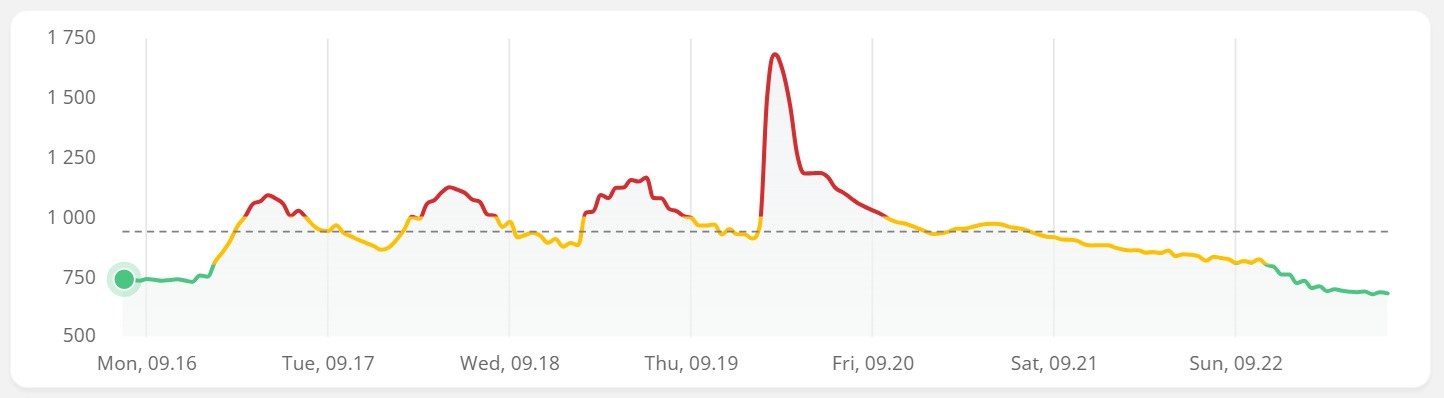
We see elevated CO2 in sealed rooms, especially when people are working in them. Say you have a server room: Even powerful IT-grade air conditioning might not help as much when the room itself is sealed for fire prevention (and this is a common requirement). Here’s an example we’ve seen in the field, reporting on daily CO2 levels over the course of a week:
Red means CO2 levels that are high enough to flag as a potential problem. At these exposure levels, people might start feeling “off”, including symptoms like headaches.
This server room was indeed a sealed environment – good for containment if there’s ever a fire, but bad for cycling out carbon dioxide. Instead, CO2 whooshes around the room and even with that server-room strength AC blowing, the room design makes it difficult to dissipate.
The smaller red peaks are during the week, possibly with staff in the room for a limited time. We can also see how levels slowly drop to normal over the weekend, when the room is more likely free of humans.
Hey, what’s the large red peak? Why, that was a coworker and me! We were hanging out for a few hours, working on work, and, well… breathing. Our human exhaust spiked the CO2.
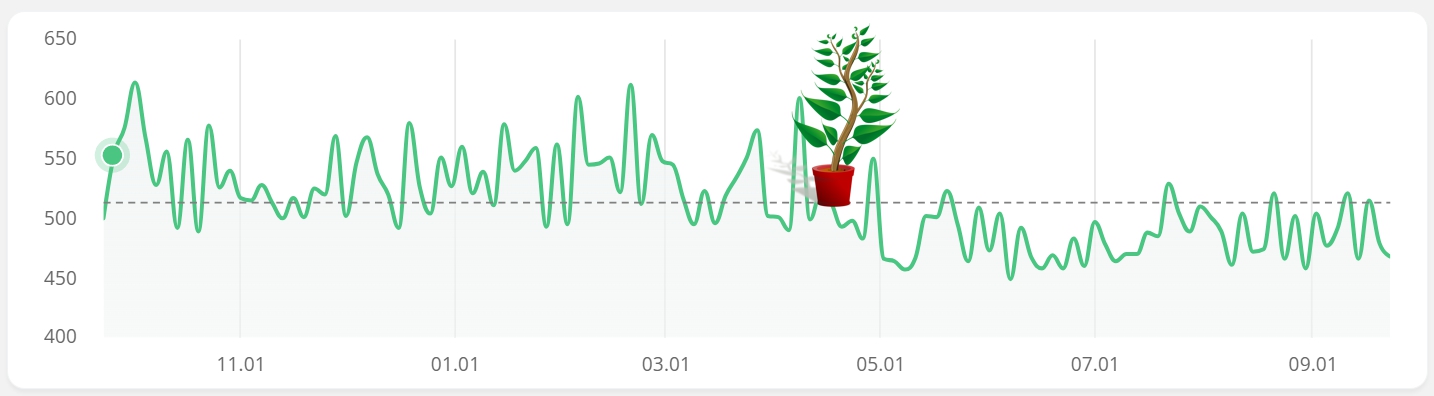
For a more fun and less controlled example, I’ve got another CO2 monitor in my own office. It’s also “sealed”, to the extent where I close the door every day when I leave work. Check out the levels:
Not too bad, as measurements are all in the green. But also notice in mid-late April, the CO2 dropped lower than it had been the last six months.
There was a change in my office in mid-late April: I put four plants in my office. Plants inhale carbon dioxide and exhale oxygen.
I did not expect to see this result, and wasn’t measuring for plant impact, so won’t claim any scientific legitimacy for this report. But the measurement changes timed so close to my plant installation, the office CO2 reduction caught my attention faster than a bug on a Venus fly trap.
There are many fixes for office CO2 levels (consult your favorite HVAC specialist), so you can breathe easy, but CO2 is still something to be aware of and plan for, specifically in business settings.
Kaiser IT Group provides managed IT, cybersecurity, cloud, network, and business technology services for organizations throughout West Michigan. We help businesses improve reliability, strengthen security, and make better technology decisions.