One thing I’ve learned over the past 27 years working in IT is that being good with people matters just as much as being good with technology.
I’ve seen what happens when it goes the other way. A user runs into an issue and hesitates to reach out because they’re worried about how the interaction is going to feel. That hesitation usually turns a small problem into a much bigger one.
I never want someone to feel that way about contacting IT.
When someone comes to me with an issue, I want them to feel comfortable. I want them to know they’re not going to be talked down to or rushed through something they don’t understand.
When that trust is there, everything gets easier. People are more willing to walk through steps, more open to trying things, and honestly, more relaxed through the entire process.
One thing that has helped me a lot is using analogies. Not everyone thinks in terms of servers, networks, and permissions, but most people understand everyday situations. If I can explain something in a way that connects to what they already know, it just clicks. You can almost see the moment it makes sense.
Here’s a real-world example I’ve used.
We were in the middle of transitioning a client’s environment. The Active Directory had already been migrated, but the VPN and network infrastructure were still with the previous provider. Because of that, remote users would sometimes lose access to their mapped drives and understandably become frustrated.
One user reached out and asked why this kept happening and why it couldn’t just be fixed.
Instead of getting overly technical, I explained it like this:
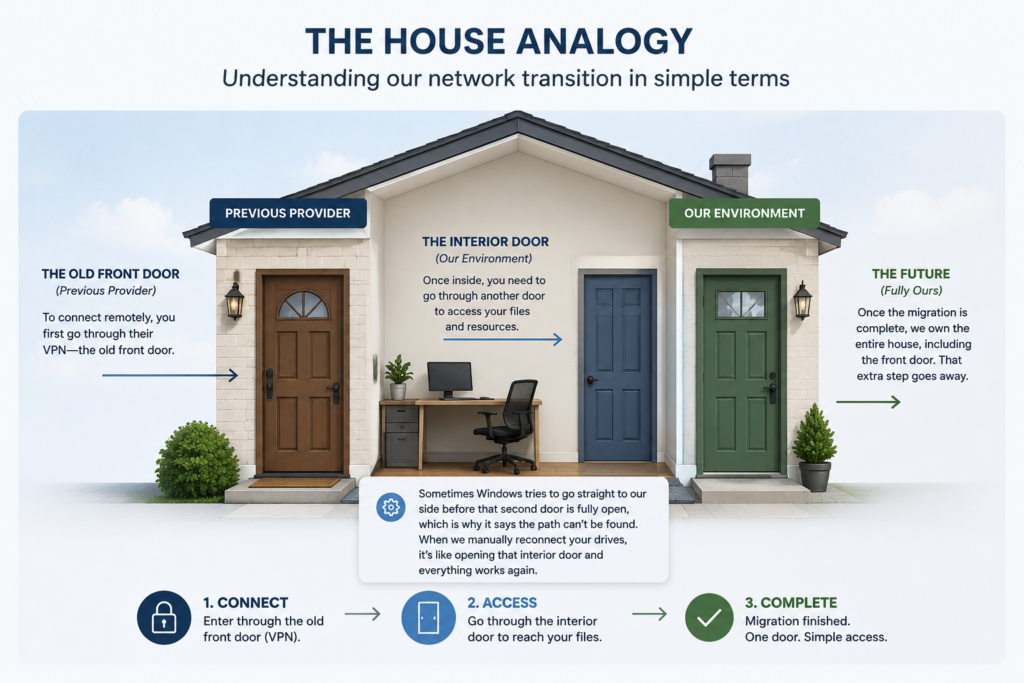
Right now, it’s like you’re working in a house that’s being renovated and is still partially owned by someone else.
We manage everything inside the house, but the front door still belongs to the previous owner.
So when you connect remotely, you first have to go through their front door using the old VPN. Once you’re inside, you then have to pass through another door into the part of the house where you access your files.